
 Alexx Aplin
 Alexx Aplin
Since it was announced last year, I’ve been greatly excited about Fire Emblem: Fortune’s Weave. Seemingly a prequel to Fire Emblem: Three Houses, I’m eager to dive back into Sothis’ world and see what is coming to Fodlan. Now, Nintendo has revealed a 20-ish minute direct filled with info on what is to come when Fortune’s Weave launches. Let’s get into it.
Fortune’s Weave will be set in the Dagdan Empire, which was only mentioned in passing in Three Houses. Dagda is “ruled by the gods,” and we will be spending time in Dagsion, the capital city filled with temples, markets, and more. This is also where the Heroic Games will be held, which happens to be a centerpiece of our newest tale.

The king of Dagda, Solel, will grant a single wish to the winner of the Heroic Games. The Direct went over the four different story paths available in Fortune’s Weave. I can’t help but wonder if there is a true route this time, or if each route will provide a largely different tale.
Cai’s route involves a young boy living in a peaceful village. On his fifteenth birthday, his father is imprisoned in Dagsion. Cai sets out with childhood friends to win the Heroic Games, so that he can free his father. Fire Emblem has a history of killing dads, so I can’t help but be concerned for his father’s chances.

Dietrich’s route involves a warrior ever in search of a stronger opponent. After being attacked by a monster while sailing, he finds himself washed up on Dagda’s shores. Dietrich joins the heroic games to slake his thirst for battle. I can’t help but notice that Dietrich is using a weapon similar to the Crest Weapons from Three Houses. Perhaps he is related to Edelgard in the future, or there is something else at work.
Next is Theodora’s path, involving a woman who hails from the southern kingdom of Saramis. Theodora’s people worship the goddess of night and death, who is reviled and hated throughout the lands. Theodora aims to restore the honor of her goddess and defend her people’s faith, using the Heroic Games as a way to reach that goal. Could she be connected to the antagonists of Three Houses known as “Those who slither in the dark?” Or could this be a red herring?

Lastly, Leda’s path involves a young woman filled with rage following the murder of her father. Leda discovers that her father’s killer plans to participate in the Heroic Games, and joins in order to seek revenge.
This led to a segment on how the Heroic Games work. Similar to other Fire Emblem games, you’ll pick your allies and then set their positions on the field. Combat basics are similar to other games, such as character ranges being shown in blue, the triangle of weapon resistances, etc. As in previous games, each weapon type has advantages and disadvantages, such as spears being useful against cavalry, gauntlets making it easier to evade, etc.
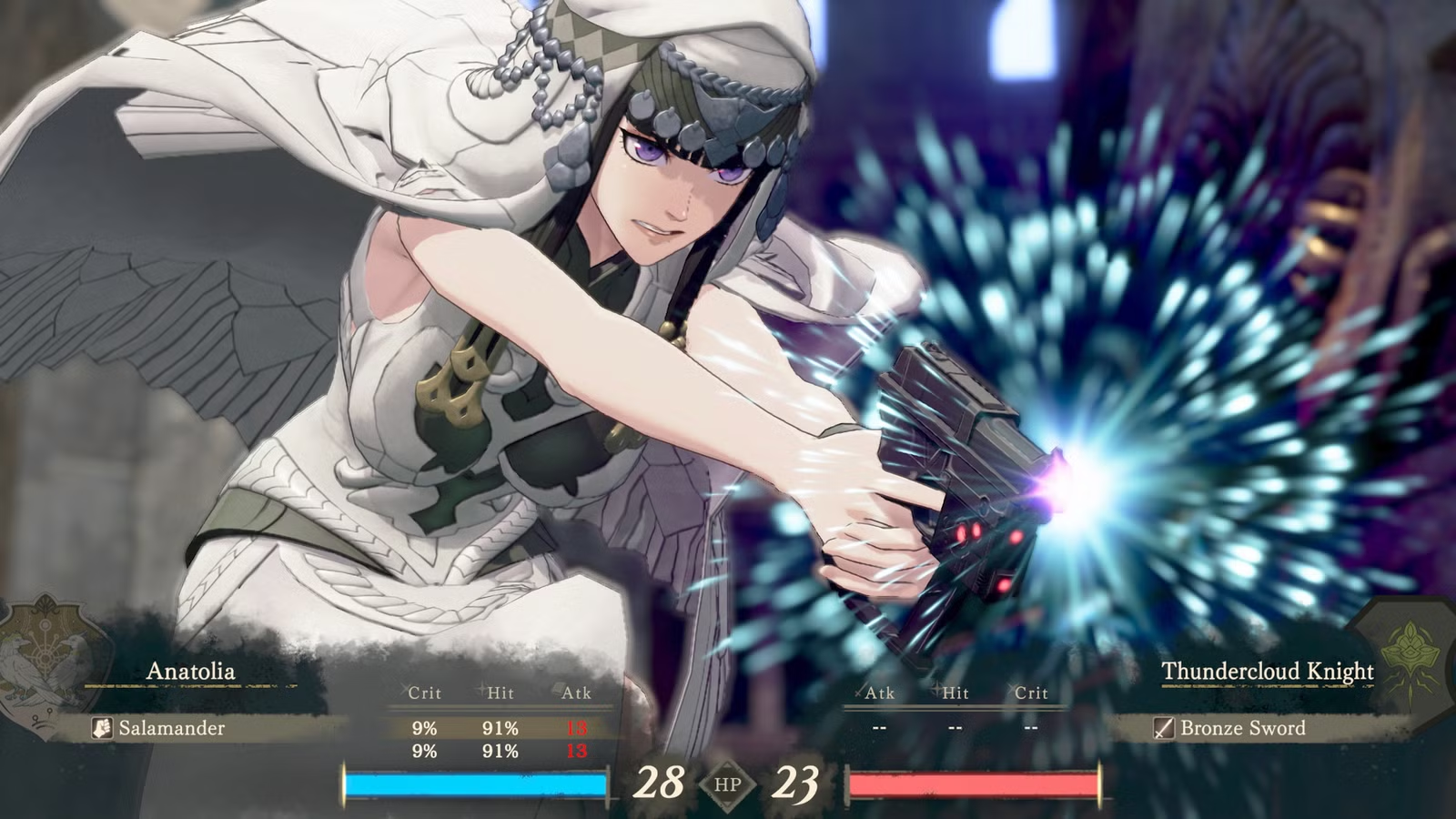
One thing I noticed during the direct is that it seems (unless my interpretation is wrong) that they have merged Magic and healing Rods together into one weapon type, so that magic users can heal, etc. This makes sense considering previous games have recently made it so healers can get experience from healing, not just attacking.
Combat Arts return from Engage and Three Houses, offering an array of attacks with chosen weapons. Combat seems both fresh and familiar to veteran players, which I like. Interestingly enough, they introduced Blaze Arts, abilities that “consume your soul.”

Unsurprisingly (considering Sothis is involved), players are also able to rewind time, like in Three Houses. So, if you lose a teammate, you can rewind and re-adjust your strategy. This is a helpful quality-of-life option for players such as myself who prefer “no death” runs of Fire Emblem games.
The direct also dove into the different class options, split into Beginner, Specialty, and Advanced tiers. Some of the newer classes are really interesting, such as the Charioteer class that lets you drive a chariot into enemies. Others are more familiar, such as the Gladiator or Archer classes.

They snuck an interesting detail into the Direct. One of the characters involved in the game is Seteth, who seems to be the same from Three Houses, just younger. Will we see his origins? He is long-lived after all, due to the powers of the goddess.
In between matches, you can improve your team by venturing out into the world or spending time in Dagsion. In Dagsion, you can receive additional arena training once per in-game week. You can buy weapons and items at the Shopping Arcade. You can also upgrade weapons in the Shopping Arcade if you’d rather enhance what you already have.

Temple Row lets you volunteer at a temple, getting blessings according to which temple you spend time in. Each temple offers different bonuses, and the bonuses can help you in your battles.
Dagsion is also where you take your certification exams to change classes. It is really interesting how Fortune’s Weave has added Three Houses’ learning and training, while seemingly keeping things somewhat unique.

You can also recruit powerful warriors you meet in Dagsion. However, you’ll have to meet their standards in order for them to join you, of course. Three Houses’ gifting has returned to help you get characters to join you as well.
Another quality-of-life feature is the ability to utilize Inns to automatically let time pass, setting all your party’s activities to run on their own. This is great for people who don’t want to micromanage as much as Three Houses required. Personally, I’m a big micromanagement guy, so it won’t get used as much for me.

The developers have also offered the ability to play through all 4 stories in parallel. This likely connects to what comes after the Heroic Games, but that’s just speculation for the moment.
Traveling on the world map not only lets you shop at town merchants, but also allows you to find information for your journey. You can also train your party through combat, which is helpful as you work through the Heroic Games. Dungeons also return from Fire Emblem Echoes, letting you collect materials for weapons as well as other treasures.

Fighting in Dungeons allows you to partake in turn-based battles different from the strategic ones Fire Emblem fans are used to. This is quite a surprise, and one I’m very interested in experiencing.
Then, the Direct teased something surprising. A five-year time skip after the games, which normally would be left for release. Five years after the games, the Demon God Balor is awakened, and the land of Dagda faces its end. The four heroes of the games have vanished, and now you (named Eshmel) are summoned by Sothis to fight the dark god.

You can either face the god Balor on your own or use the goddess Fortuna’s powers to go back in time and change the fates of the 4 heroes. This is the true story, seemingly allowing you to gather all 4 heroes together, preparing in those 5 years to face the Demon God. It honestly feels like a story from Radiant Dawn or Path of Radiance, which is really interesting.

Fire Emblem: Fortune’s Weave will be available on September 17th, 2026. After the Direct, Nintendo Music was updated with select tracks from Fortune’s Weave including the main theme. With that, the Direct ended, and I find myself even more excited for Fortune’s Weave than before.
The development team seems to be trying some new things with Fortune’s Weave, while giving fans what they liked from Three Houses. I’m curious to see how the turn-based dungeons play out, and I’m even more curious to see how deep the connections go between Fortune’s Weave and Three Houses. Regardless, I’m excited for the September 17th release date.
Phenixx Gaming is everywhere you are. Follow us on Facebook, Twitter, and Instagram.
Also, if you’d like to join the Phenixx Gaming team, check out our recruitment article for details on working with us.
Phenixx Gaming is proud to be a Humble Partner! Purchases made through our affiliate links support our writers and charity!
Discover more from Phenixx Gaming
Subscribe to get the latest posts sent to your email.


